A private space, not a public server
Many community apps are built to help strangers find each other, with directories, search and discovery pages. Minamo deliberately has none of that. Channels aren't listed anywhere, can't be searched for, and are never indexed by search engines.
That makes Minamo a poor fit for growing a big public audience, and a good fit for groups whose members already know each other, or are brought in by someone who does.
Invites that expire on their own
To bring someone in, you create an invite code and share it however you like. Each code expires after 1 hour, 1 day or 7 days, and you can limit how many times it can be used.
So a code that ends up somewhere it shouldn't stops working by itself, and a code meant for three new members can't let in a thirtieth.
Rooms for every kind of conversation
A channel is made of rooms, and you choose which ones it has:
- Text rooms for everyday chat
- Forum rooms for posts with replies, so plans and questions don't scroll away
- A rules room, so everyone knows the house rules
- Voice rooms where up to 8 people can talk
Owners, moderators and members
Every channel has an owner, and owners can make trusted members moderators. Together they look after the channel, and people who break the rules can be banned.
Anyone can also report a person, message, channel or forum post to Minamo's own moderators, with a reason. More on safety.
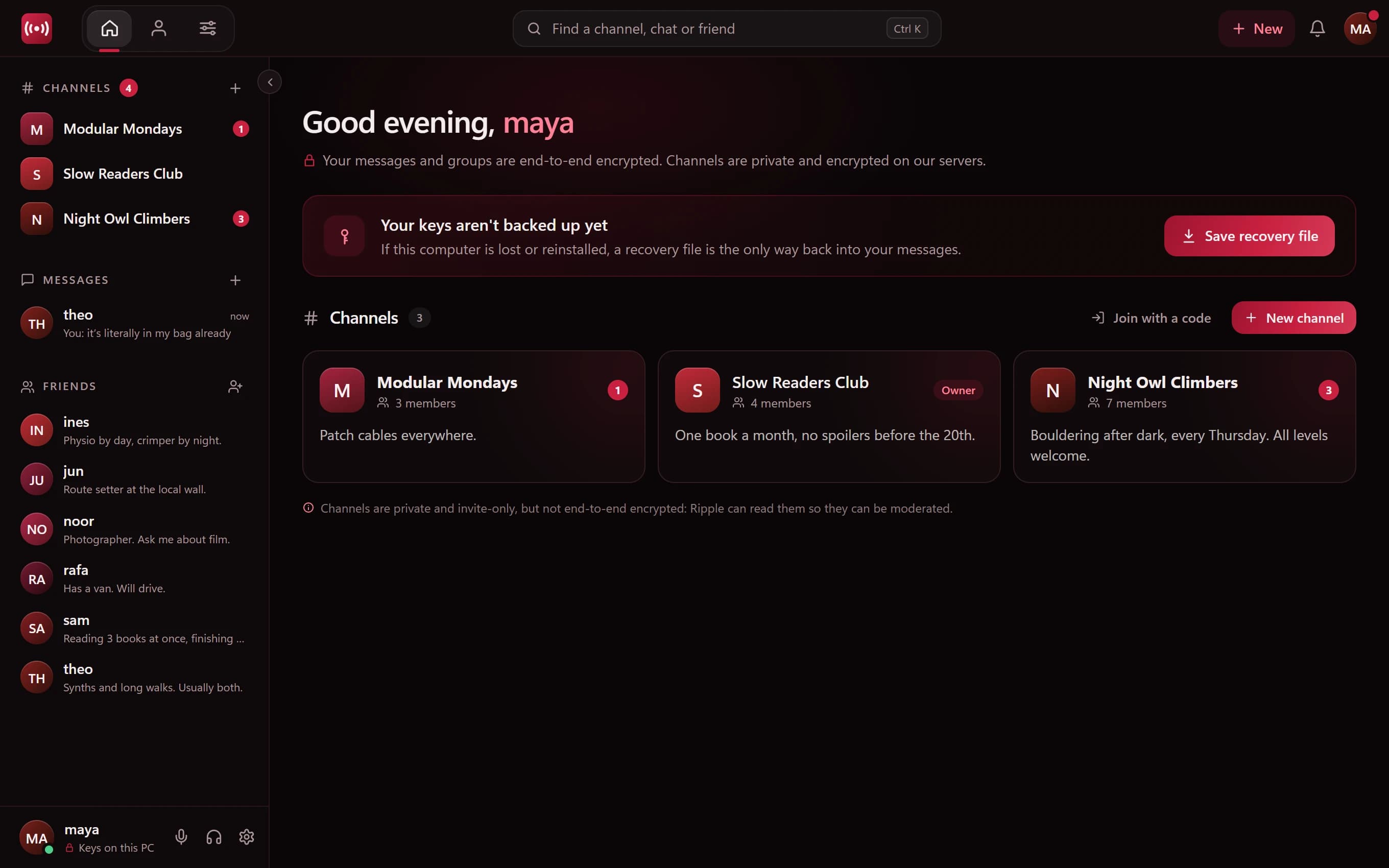
Encrypted on our servers, but not end-to-end encrypted
This is the part we want to be completely clear about. Channel content is encrypted at rest on Minamo's servers with AES-256-GCM, using keys that Minamo holds. That protects it in storage, but it also means Minamo can decrypt it.
We chose this on purpose. Channels can hold many people who don't all know each other, and when someone reports harmful content, our moderators need to be able to look at it. It also means Minamo can respond to lawful requests.
To keep that ability in check, every time an admin opens channel content it's logged, along with the reason. And the app labels channels "Not end-to-end encrypted", so nobody is misled.
When you want a conversation nobody else can read, use a direct message or group chat. Those are end-to-end encrypted.
Questions
Can people find my channel by searching?
No. Channels are never listed, searchable or indexed. The only way in is an invite code from someone in the channel.
How long do invite codes last?
You choose: 1 hour, 1 day or 7 days. You can also limit how many times a code can be used.
Are channel messages end-to-end encrypted?
No. They're encrypted at rest on Minamo's servers with keys Minamo holds, so moderators can review reports and Minamo can respond to lawful requests. Every admin access is logged with a reason.
Who can moderate a channel?
Each channel has an owner, who can make members moderators. People who break the rules can be banned, and anyone can report content to Minamo's moderators.
What kinds of rooms can a channel have?
Text rooms, forum rooms for posts with replies, a rules room, and voice rooms for up to 8 people.